JUST BECAUSE YOU CAN
(Doesn't Mean You Should)

This, principally, is how I think about my writing. The fact that we can write and post with such immediacy and to a waiting audience makes the prospect of writing inviting. But often, after I share something I’ve written, I find myself thinking that maybe all of it would have been better left unsaid.

***
Some people read what I write. A few who read what I write reach out to me (not enough[1]). A former colleague wrote to me and said, “You never were the smartest guy in the room.” That was all he wrote. I wasn’t sure how to take it, which possibly underscored the point he was trying to make.
Hardest working? Possibly. Savvy. Admittedly. But smartest? Nope. Evidence: I sometimes cast aspersions on companies and their work. In my public writing.
Another reader writes, “What, exactly, are you doing here? You seem incapable of celebrating any of our industry successes.”
Admittedly, publishing has had success in keeping employee unions at bay.
***
I could point to successful publications in our industry and write about those. But often books become successful due to a constellation of circumstances having little to do with publishing or publishers. And that is less interesting to me. There is good and bad luck in publishing, and good and bad timing, too, and these elements have always played a somewhat outsized role in how books perform.
I will read outlier publications, books that become constants on bestseller lists, to see if there is some kind of thread or hidden key in the text that explains why they have become sticky. A recent example: The Correspondent. It is an epistolary novel that has been on bestseller lists for several months now. I found it a good enough book, and possibly, its success has something to do with our nostalgia for letter writing.
You can go back over history and review books or series that became part of the cultural firmament. Many had (have) a unique attribute you could (can) point to that would explain some of what was happening, whether it was (is) our fascination with symbology conspiracies, contract kink, child gladiators, grief porn, yuppie psychopathy, or faerie smut.
That’s not to say good publishing doesn’t play a role. It does. And a lot of that has to do with inception – the editor and their nose (singular). That (they) has (have) always been the lifeblood of publishing.
I see a future where editors will do more work, and possibly, all of the work that has historically been amortized among different departments (absent production and sales). Sorry!
***
Absent the editor, much of the historically necessary work of conglomerate publishers remains diminished. Example: distribution. That was one of the reasons to sign with a Big Five publisher back in the day. Publishers would use their muscle to get your books into retail channels, and boy oh boy, there were a lot of them. Now? We have three primary retail channels: Amazon, B&N (the blonde wood store), and the indies. That’s a phone call (or three).
Inventory management was another reason. Publishers could manage stock and replenish it in a heartbeat. I recently had an experience with a Big Five author/client whose book went out of stock before it went on sale - something I thought impossible (it isn’t).
***
I recognize that the world and logistics have changed. Still.
***
I have a friend who shared her publisher’s foreign rights submission list with me. There were editors and imprints on that list who would not ever consider her book, and obvious editors and imprints that would were missing from it. It was a pro forma list demonstrating pro forma work being done on her behalf.
Another reason: publishers had money to invest and spent it freely. Now? Don’t get me started.
***
We can’t send them a book.
What do you mean, you can’t send them a book?
They didn’t ask for a book.
We have to ask their permission?
They have to request a copy. BEAT. We can send them a NetGalley link.
Some colleagues in the media prefer physical books.
They have to say so. In an email. With their address. BEAT. Mailing books costs money.
***
A final reason (and still the reason): ego. Just to say the words. For the gratification accompanying that Publishers Marketplace post.
***
There’s still a hint of arrogance with Big Five publishers (we know what we’re doing). We know the best copy, cover, metadata, marketing, and publicity for your book. I am here to say: they don’t all the time. And so, as they are doing their work, be a partner to them. Request to see the TI sheet, BISAC categories, comp titles, selling points, first printing, distribution, metadata keywords, look-alike audiences, positioning, media lists, etc. If you are unclear about something, ask for an explanation. Authors seem to forget one very important thing in all this: it’s your book. You are the talent. And that you, as the talent, as a person with a vested interest in the outcome of their work on your behalf, can (and should) 1. Ask questions, and 2. Challenge. Because it’s hard to course correct down the line.
Always think about this: what are you getting for your fifteen percent? And why did you sign a contract where you don’t get cover approval?
***
That the game has changed as much as it has presents an opportunity for smaller publishers to compete with big publishers. There are some recent entrants to the game who are doing just that. I have industry colleagues who look at some of the smalls and snicker. My advice: don’t. They are working harder than you are. Admire their hustle. Cheer for their successes. They make our business more interesting.
That the game has changed as much as it has presents an opportunity for authors, too. Where you publish is no longer automatic. You have options. Explore them.
***
Unlike publishers, I will admit that I often don’t know what I’m doing. And that I don’t have all the answers. This came up in a recent call with an author.
***
What relationships do you have that publishers don’t?
You mean our secret list of contacts?
Yes.
There are no secret lists.
Well, you must have ways to unlock bookings.
A magic key?
Yes.
There is no magic key.
And there are no secret lists.
Correct.
Then why should I hire you?
You shouldn’t. BEAT. You should hire a magician instead.
***
This absence of magic keys, secret lists, or known outcomes is why I enjoy collaborating with others, including publishers (though I still do not accept work from them). Success here – and there are many definitions of success beyond the obvious – is achieved by getting all the notes right at the outset, by being scrappy, by having enduring relationships, and, ultimately, by not being full of shit.
That said, if you work with a client long enough, you’ll figure it all out.
***
“Ultimately, the only things that will survive from our civilization are plastics, twinkies, Keith Richards, and Robert Caro.” @CT Mathewes
***
It is easy to cast aspersions on the work of others when so many know not how to do their job or are hemmed in by corporate constraints. This is, perhaps, the only reason I still have a job, because so many writers have lost confidence in the work of others, or fear that the work of others is being amortized among AI agents.
On the other hand, some colleagues are very good at their jobs, and I will confess that I often take their work – and their fight for the right outcomes – for granted. Example: I get frustrated by colleagues in the media who are cagy when pressed about coverage (and assessments). However, they too are frustrated when they are unable to produce satisfactory outcomes for all the books they are, in theory, supposed to be assessing/covering. I was recently trading emails with a colleague at a major media outlet about this very subject, and she wrote back, “Getting books in front of readers feels impossible some days.” Trade publishing, distilled, in one sentence.
**
Things change, but not always for the better.
***
Of course, there are moments when you are successful at getting a book in front of readers. And sometimes when you do, a book develops a pulse. There are other times when you are successful at getting a book in front of readers, and nothing happens. And then there are still other times when no coverage is forthcoming whatsoever. Under the latter two circumstances, everyone is left wanting.
Sonny was famous for wanting to examine such failures. He would call a post-mortem meeting (grim), and everyone would be sitting around the conference room table staring at their lap.
***
What happened?
Quiet.
What the fuck happened?
Still quiet.
Does anyone know what the fuck they are doing here?
***
This compounded the failure by making everyone feel miserable. Sonny wasn’t perfect.
***
Some say AI is making things better. Indeed, you can now deploy AI to help make you the smartest person in the room and reduce the possibility of failure. The internet will tell you that the most effective way to use AI is with prompts, and that asking the right questions will guide you to answers you might not have thought of yourself. You will come to meetings armed with ideas, none of them yours. I suppose this is fine, though I would argue you are better off doing the thinking yourself. Because, you know, that’s what you’ve (we’ve) always done, and as wonderful as AI seems, it is the lazy way out, and soon, you will not be able to think at all. Also, AI was built on theft, mostly. So, you will be stealing. Finally, if everyone does this, we will run out of water next week. We will turn into a nation of dumb, thirsty thieves.
***
“You’re doing it too fast. You’re not thinking enough. You have to make yourself think.” – Robert Caro
***
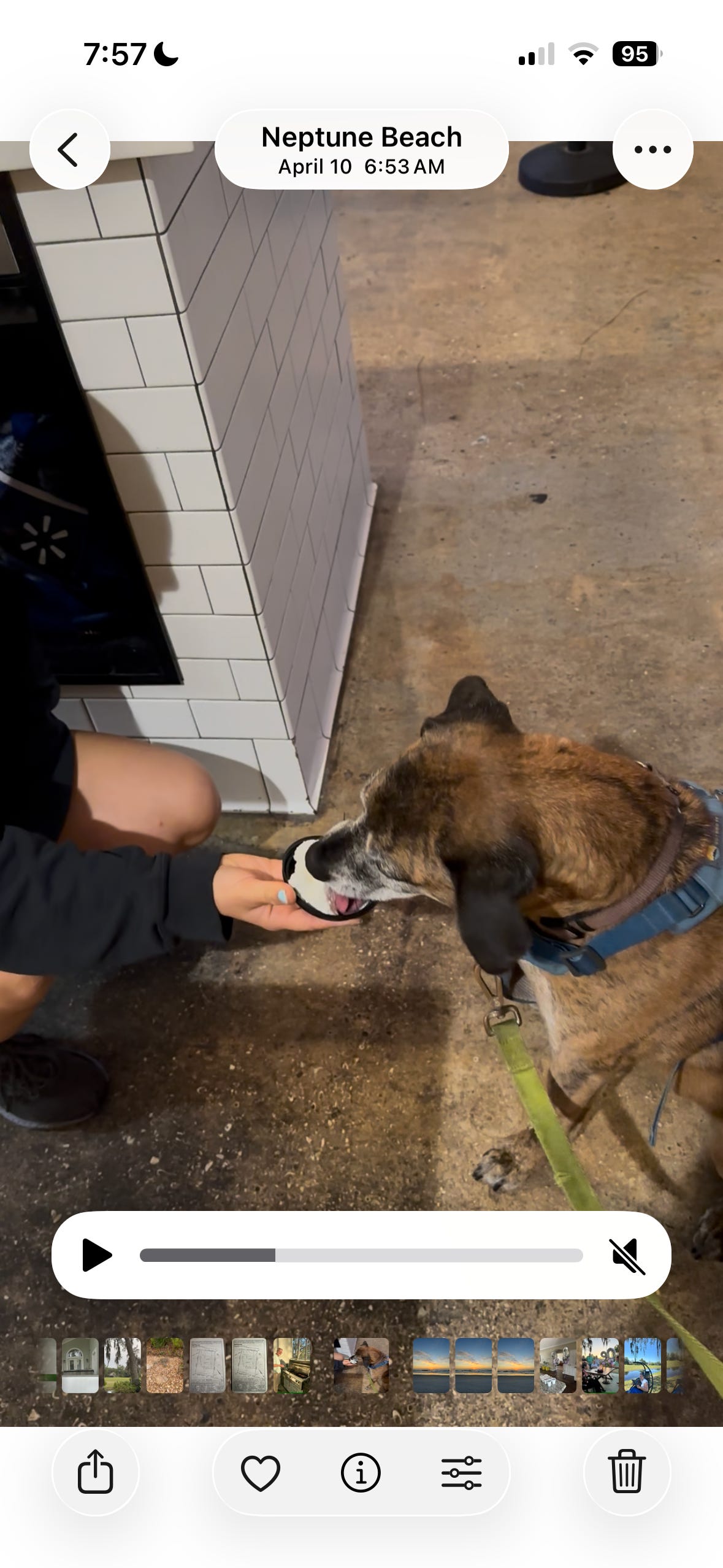
I recognize that the repository of knowledge AI is drawing from is significant – all of human history, stolen (though I am not a scientist or scholar) – and so good prompts will lead you somewhere. But one thing AI is not is sentient. Where it will lead you is someplace the world has already been and not so much where it is going (which is, ultimately, what we all want to know). My own experience with AI suggests that its thinking is limited and not unlimited, and that it moves in a linear way. I’m more of a circle guy and feel better running questions conversationally through my barista at Southern Grounds, who is the nicest person in Florida. She gives Tigger a pup cup every morning. Try asking AI to do that and see how far you get.
***
Then again, I am probably wrong about all of this stuff.
***
One thing I like about AI: it’s responsive. In a world where weeks can go by before anyone returns an email, AI’s responses are immediate. In the real world, there is a hierarchy of response rates, based on who you are, who you are writing to, and who you are writing about. It is vulgar and hardly democratic and can leave you feeling orphaned.
I’m pretty good at responding to people (if I haven’t responded to you, I apologize).
I always make a point of responding to authors. Some might not like what I have to say. I’ve taken a few meetings with authors recently and told several that it didn’t make sense for them to hire us (or anyone). I had one last week where I said to an author, “Lean on your publisher. It’s their fucking job, and as far as I can tell, you’re doing all the heavy lifting for them.” I may be the singular force putting publishing PR agencies out of business, though that is not my aim. My aim is to save them, and authors, from the coming cataclysm. There will still be business, just less of it. Kind of like what’s happening with babies.
***
I am not sure if our declining birthrate is tied to people not wanting children or not having sex.
Sex, too, has changed. It, like trade publishing, seems diminished—a view.
***
My lack of copious intellect has sometimes handicapped me in publishing beyond my being judgy and writing posts about how fucked up our business is. Example: It was challenging for me to engage with Carol Janeway in a meaningful way. Carol (Oxford) was the smartest person in publishing by a mile and the only person who intimidated Sonny (also Oxford). I may have referenced this in a previous post – stay with me. Carol published Schama, Schlink, Mann, Musil (etc.), was fluent in several languages, an adept translator, a shrewd negotiator of foreign rights, and did not care for corporate politics (at all). She had an easy laugh and was sexy in an intellectual way, the kind of woman who might agree to undress in front of you if you started reading from The Man Without Qualities aloud. She was miles out of my league, and yet.
Throughout her career, Carol remained something of a quiet figure on the world stage of publishing. I loved her pragmatism. Her expectations were never out of line. She had sound ideas and appreciated the work you did. She understood when a writer was being unreasonable. She invited me to lunch once, and the first thing she said when we sat down was, “We’re not going to talk about work.” One can ask nothing more of a colleague.
***
When you are the person who is ultimately in charge of earned media coverage for a list of books, editors will sometimes try to seduce you[2]. Their aim is to bend you to their will, and there is no limit to how low they will stoop in their effort to get you to do so. What they ultimately want is not you but your undivided attention on one of their books.
Authors want this too. And agents. Ours is a world of want[3].
***
There is a hierarchy of want. The first want is for attention, the second is for success, and the third is for sex[4]. There are a handful of authors I’ve met in my lifetime who were (are) comfortable with success absent attention. None of them were men. Male writers thirst for attention and success because it sometimes translates into sex. Some authors, as they age into their writing careers, are comfortable with less attention (and sex) as long as they remain successful. But most exist on a plane where they want success and attention and the possibility of sex for as long as they are alive.
Women writers have been easier to work with. I realize this is probably a gendered view of the world. I’m sorry[5].
***
The hierarchy of want for editors is a little different. The first want is for their book to succeed for them; the second is for it to succeed for their editorial aura; and the third is for it to succeed for their author. There is nothing wrong with that.
***
Publicists’ needs are simpler: they want a book to succeed so they can keep their jobs.
***
I had an editor come into my office one morning, shut the door, sit down in the chair across from me, and say, “I had a dream about you last night.” The penultimate stoop.
***
Really?
Yes.
A sexy dream.
A sexy dream?
Yes. BEAT. You were naked. BEAT. I was naked.
***
An extreme example of want.
Now, this was back in the day when such things would go unreported. And so, I sat there, in my chair, visibly uncomfortable, unsure what to do.
***
Am I making you uncomfortable?
A little.
I’m sorry. BEAT. I just thought you should know.
Is there anything else?
Isn’t that enough?
More than enough.
I could go on.
Better that you don’t.
It was a hot dream. BEAT. Is it hot in here? (and she began fanning herself under her chin with her hand).
Yes. BEAT. Maybe you should open the door.
Are you sure?
Quite.
***
Carol would never have stooped to something like that. But others? This is what made office life interesting back in the days when people had office lives.
***
There were other situations, too. I once had an assistant who would use jiffy mailers to send panties to men she had coupled up with. I did not know she was doing this while she was doing it – using company resources for such a thing would have been a clear violation of Bertelsmann policy[6] – and I only found out after she left, when my new assistant came into my office and stood in front of me with a yellow jiffy mailer.
***
Hello.
Good morning, Kate.
Do you know what this is?
A jiffy bag.
I mean, do you know what is in here?
A book?
No.
And then, gingerly, she handed me the yellow mailer.
Take a look inside.
OK. BEAT. (Looking inside) Oh my goodness. BEAT. Are they yours?
No!
Then whose are they?
I have no idea. BEAT. This is my first day, remember.
Right. BEAT. OK. Thank you for bringing this to my attention.
There are more of them.
More what?
Mailers with panties in them.
More? Where?
In my desk drawer.
Oh Jeezus.
And at that, she led me from my office to show me the stockpile of pre-stuffed panty mailers.
***
This was all very curious (there were no management guidelines on how to deal with colleagues stuffing their panties in jiffy mailers). And so, I thanked her, said I would deal with the “seriousness of the situation,” and called another colleague into my office.
Do you know anything about this?
About what?
This! I was pointing to the mailer on my desk. And then I tipped the mailer upside down, and a pair of panties slid out.
BEAT.
(Sheepishly) Possibly a little.
A little?
Yes. BEAT. You know how weird Angela was.
Uh-huh.
It’s just something she did.
And you knew about it?
We all knew about it.
And no one told me?
What would you have done with that information?
I don’t know. BEAT. Please assure Kate that I had nothing to do with this.
Of course.
Thank you.
***
There are people still working at Knopf who can verify this story.
***
What does all this have to do with publishing today? Well, there are some things you should never take for granted (as in, how hard your colleagues in the media are working). Also, you need to pay attention to what is being mailed to colleagues. Finally, how much of this post would have been better left unsaid?
Of course, if you are struggling to get the attention of a media colleague, you could try what Angela had been doing for several years while she was my assistant: send them a book and a pair of panties. And not just because you can, but because you will be acting in defiance of the mail book police. I guarantee that will get you a response from someone.
Until next time,
Kill Your Darlings
[1] Think of this as an opportunity. Write to me, text me, challenge me, send me a sexy poem (!!)
[2] This is true of any person who is in a position to help an editor bring their book to an audience.
[3] All this wanting starts to wear you down. Eventually, you turn to dust.
[4] Unless you are a Millennial or Gen Z. They have no interest in sex.
[5] For everything.
[6] Code of conduct, page 34, paragraph 19: “Mailing panties in jiffy bags: verboten!”
dumb question- when you said to ask your publisher about distribution, what do you mean exactly? Isn't it just Ingram? ie, big box and indies placing orders.
First of all, I love reading you. When you arrive in my In-Box, I dive right in.
Now. I was in publishing for about 5 minutes back in the 70s/80s, so this statement, which I quote from a piece I wrote about 20 years ago comes from relative ignorance. But I still stand by it.
"Great fiction is hard to sell. What happens to a person who reads a book -- if it's any good ¬-- is a profoundly private and irrational process, and the more distinctive the novel, the more private and irrational the process. That's where the trouble with publishing begins."
Since then I've come to understand that "great fiction" is a slippery category. Different books appeal to different readers; there are many different kinds of books, many different motives for reading. The editorial process of choosing a manuscript and working with its writer and standing up for the final product seems both vitally important and a mystery. Just some thoughts.
I so appreciate the light you shed with every post.